Camera ControlSubject ControlScene RevisitTerrain InteractionObject InteractionSocial InteractionPhysical ReactionGoal Completion
🗂️
1,474
Test Cases
First- and third-person viewpointsHuman, animal, vehicle, and robot subjectsOutdoor and indoor real scenes3D renderings, cinematic footage, close-up views, animation, and dashcam videos
Overview
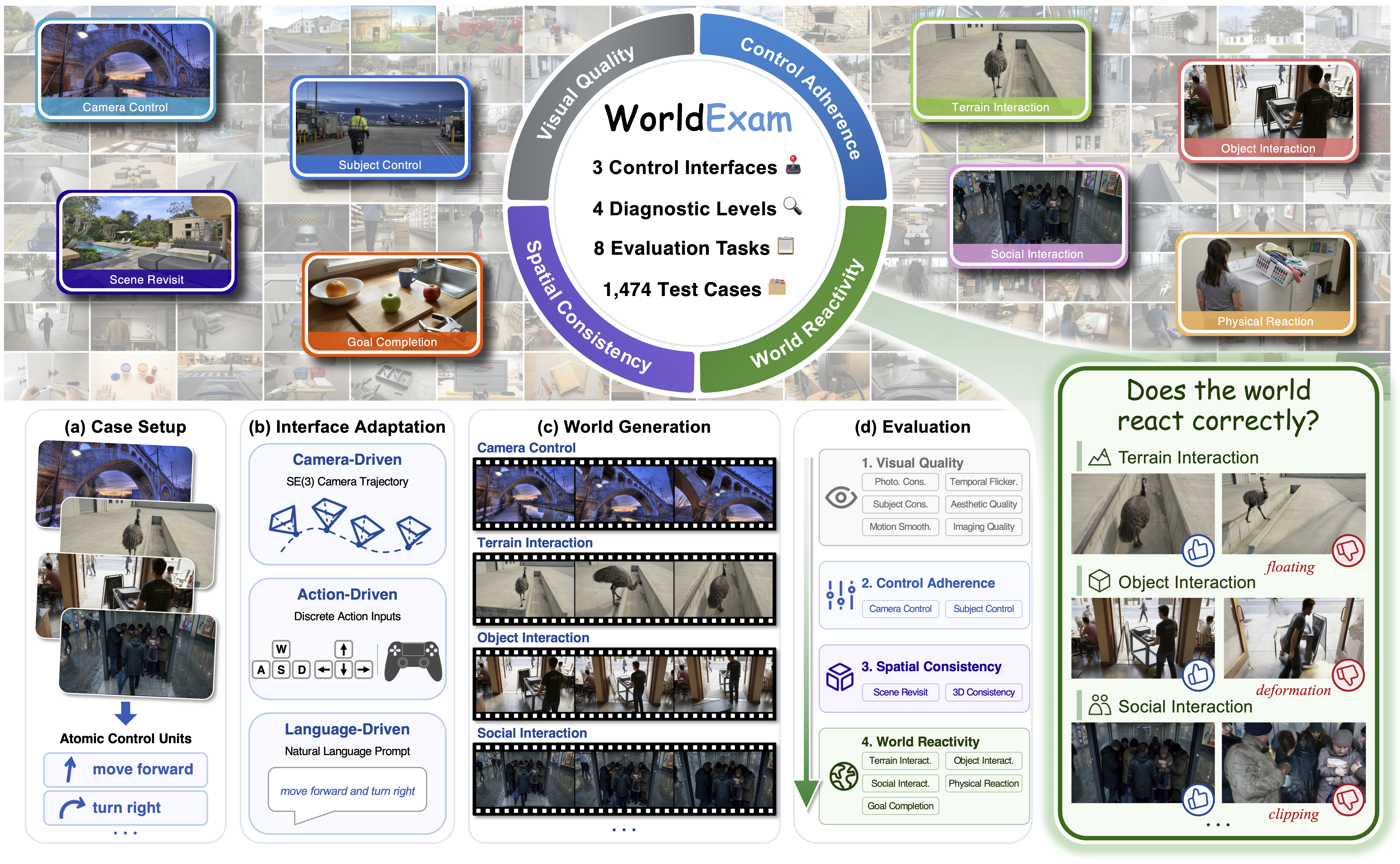
WorldExam is a hierarchical diagnostic benchmark for controllable video world models. Beyond visual appearance and explicit instruction following, it asks whether a model preserves a coherent world and exhibits inherent reactivity. Across camera-, action-, and language-driven interfaces, WorldExam organizes 1,474 test cases into four diagnostic levels and eight dedicated tasks under a unified evaluation protocol.
Inherent Reactivity: the ability to infer from the scene state how the world should react and to generate plausible consequences not explicitly described in the input
World Reactivity level evaluates scene-conditioned reactions and goal-directed behaviors beyond what is explicitly specified in the input.
Interactive diagnostic map
From control interface to diagnostic evidence
Four diagnostic levels map to eight evaluation tasks, which are assigned to static-scene or dynamic-interaction tracks according to scene assumptions and model applicability. Each track reports task-specific and general metrics.
01
Control Interfaces
Camera-drivenAction-drivenLanguage-driven
WorldExam represents controllable behavior as an ordered composition of atomic control units and adapts this control intent into an SE(3) camera trajectory, a discrete action sequence, or a natural-language prompt.
02
Diagnostic Levels
Core capability
World Reactivity
By contrast, the World Reactivity level evaluates scene-conditioned reactions and goal-directed behaviors beyond what is explicitly specified in the input.
The dynamic-interaction track contains Subject Control and the five World Reactivity tasks and applies only to compatible action- and language-driven models; Goal Completion is language-only.
Comparison
Comparison with representative world-model benchmarks.
The table compares supported model paradigms, viewpoints, task coverage, case counts,
and evaluated models.
Benchmark
Model Paradigm
Viewpoint
WorldExam Evaluation Tasks
#Cases
#Models
First Person
Third Person
Camera Control
Subject Control
Scene Revisit
Terrain Inter.
Object Inter.
Social Inter.
Physical React.
Goal Compl.
WorldScore
C / L
✓
✗
✓
✗
✗
✗
✗
✗
✗
✗
3,000
20
MIND
A
✓
✓
✓
✓
✓
✗
✗
✗
✗
✗
250
2
Omni-WorldBench
C / L
✓
✓
✓
✓
✓
✗
✓†
✗
✓†
✗
1,068
18
WorldMark
C / A / L
✓
✓
✓
✗
✗
✗
✗
✗
✗
✗
500
6
iWorld-Bench
C / A / L
✓
✗
✓
✗
✓
✗
✗
✗
✗
✗
4,900
14
WBench
C / A / L
✓
✓
✓
✓
✓
✗
✓†
✗
✓†
✗
289
20
WorldOlympiad
A / L
✓
✗
✓
✗
✗
✗
✓†
✗
✓†
✗
1,000
8
WorldRoamBench
A
✓
✓
✓
✓
✓
✓
✓
✗
✓
✗
600
10
WorldExam (Ours)
C / A / L
✓
✓
✓
✓
✓
✓
✓
✓
✓
✓
1,474
20
Legend
C = Camera-driven models
A = Action-driven models
L = Language-driven models
✓ = Supported / Evaluated
✗ = Not supported / Not evaluated
FPV = First-person viewpoint
TPV = Third-person viewpoint
† indicates that the instruction specifies the expected interaction consequence;
the corresponding WorldExam tasks leave the evaluated reaction unstated.
Leaderboard
Select an evaluation track and model paradigm.
Click column headers to sort the results. All retained metrics are normalized
so that higher values indicate better performance.
Track:
Model Paradigm:
Static-Scene Track
The task scores diagnose Control Adherence and Spatial Consistency,
whereas the general metrics characterize Visual Quality.
Task-Specific Metrics
General Quality Metrics
Aggregate Scores
#
Model
Average
Task-Specific Metrics
General Metrics
Overall
↕
Task
↕
General
↕
Camera Control
↕
Scene Revisit
↕
3D Consistency
↕
Photometric Consistency
↕
Temporal Flickering
↕
Aesthetic Quality
↕
Imaging Quality
↕
1
NeoVerse
85.39
93.29
77.49
97.33
89.25
98.19
70.83
93.53
52.72
72.19
2
WorldPlay
81.61
82.63
80.58
92.74
72.51
98.69
81.06
95.90
53.92
73.31
3
InSpatio-World (1.3B)
81.40
85.92
76.88
85.94
85.90
98.44
64.88
93.68
53.78
73.60
4
TrajectoryCrafter
78.00
81.68
74.31
80.32
83.03
96.98
62.83
92.56
52.17
67.03
5
Infinite-World
74.33
64.52
84.13
71.70
57.34
99.91
92.09
95.99
56.27
76.41
6
LingBot-World
70.39
58.27
82.50
58.19
58.35
99.59
81.52
96.53
59.87
75.00
7
Matrix-Game 3.0
69.28
70.30
68.26
76.36
64.25
95.59
30.14
93.40
48.80
73.39
8
Hailuo 2.3
68.64
55.99
81.28
63.29
48.70
99.38
79.88
95.33
56.30
75.52
9
ReCamMaster
67.15
53.33
80.97
38.64
68.01
99.33
81.97
95.52
54.58
73.45
10
Yume 1.5
66.02
54.06
77.97
75.67
32.45
98.44
67.53
95.18
53.42
75.28
11
Voyager
65.84
66.23
65.46
56.19
76.27
89.54
27.43
93.04
53.59
63.69
12
Wan 2.6 I2V
65.71
52.52
78.90
57.72
47.32
99.49
69.42
94.13
53.93
77.53
13
HappyHorse 1.0
65.32
50.37
80.27
58.29
42.45
99.62
74.17
95.02
55.56
77.00
14
Kling 2.5
63.98
44.50
83.46
50.18
38.81
99.87
87.87
97.56
56.28
75.70
15
Veo 3.1
60.99
41.94
80.03
40.83
43.05
99.06
73.61
95.43
55.49
76.57
16
Vidu Q3
60.24
40.90
79.57
42.75
39.05
99.43
71.28
95.01
55.38
76.73
17
Seedance 1.5
59.91
44.21
75.61
49.18
39.23
97.31
56.60
94.81
54.45
74.88
18
FantasyWorld
58.68
37.12
80.23
18.46
55.79
98.57
75.60
95.91
57.11
73.98
19
Hunyuan-GameCraft
57.59
41.55
73.62
41.33
41.77
93.61
53.93
93.91
54.97
71.69
20
Astra
57.16
35.37
78.95
32.59
38.15
96.46
78.41
96.38
51.71
71.78
Dynamic-Interaction Track
The dynamic-interaction track contains Subject Control and the five World Reactivity
tasks and applies only to compatible action- and language-driven models; Goal Completion is language-only.
Task-Specific Metrics
General Quality Metrics
Aggregate Scores
#
Model
Average
Task-Specific Metrics
General Metrics
Overall
↕
Task
↕
General
↕
Subject Control
↕
Terrain Interaction
↕
Object Interaction
↕
Social Interaction
↕
Physical Reaction
↕
Goal Completion
↕
Subject Consistency
↕
Motion Smoothness
↕
Aesthetic Quality
↕
Imaging Quality
↕
1
Veo 3.1
72.77
65.02
80.52
37.28
44.71
75.96
85.10
61.76
85.30
92.07
99.12
58.22
72.65
2
Vidu Q3
72.35
64.18
80.51
27.67
64.39
71.59
81.91
61.23
78.26
92.78
98.76
57.24
73.25
3
Hailuo 2.3
72.03
63.37
80.69
36.49
61.57
67.01
72.45
63.84
78.86
93.25
99.31
57.74
72.47
4
HappyHorse 1.0
70.57
60.60
80.54
33.11
56.30
65.70
76.17
47.01
85.33
92.69
98.85
57.37
73.23
5
Wan 2.6 I2V
66.60
52.29
80.91
29.02
49.21
44.56
66.40
48.15
76.39
94.46
98.15
56.30
74.72
6
Seedance 1.5
66.50
53.36
79.64
32.51
53.83
37.91
72.09
47.60
76.24
92.14
98.87
56.72
70.84
7
LingBot-World
60.76
39.91
81.61
55.47
24.33
25.94
60.37
33.43
—
94.98
98.89
60.86
71.69
8
Kling 2.5
60.45
39.85
81.04
28.40
35.95
27.70
66.80
31.99
48.25
96.00
99.48
56.86
71.83
9
WorldPlay
57.57
37.86
77.28
49.75
27.49
33.75
51.40
26.91
—
88.06
98.09
54.19
68.76
Samples
Representative cases across the eight evaluation tasks are shown below.
Select First Frame
Video Comparison
Gallery
Representative test cases by evaluation tasks. Hover the strip to pause.
Citation
If you find our work useful, please consider citing:
@article{yang2026worldexam,
  title   = {WorldExam: Benchmarking World Models from Apparent Appearance to Inherent Reactivity},
  author  = {Yang, Yuxue and Shang, Shuyao and Wang, Jiahe and Zhou, Zitong and Tan, Liang and Zeng, Junhan and Li, Ruizhi and Li, Junyan and Liu, Yu and Yang, Xiao and Li, Yong and Zhu, Jun and Li, Hongsheng and Tan, Tieniu and Fan, Lue and Zhang, Zhaoxiang},
  journal = {arXiv preprint arXiv:2608.02603},
  year    = {2026}
}